
The Science
Clinical, butnever cold.
Red light therapy has decades of published research behind it. Here's how it works, what each wavelength does, and where the honest edges of the evidence are.
The mechanism
How red light therapy works.
Red and near-infrared light at specific wavelengths is absorbed deep inside skin cells, by the same machinery that produces the cell's energy. Researchers call this photobiomodulation. It has been studied since NASA's early experiments on plant growth and wound healing, and the field now spans thousands of peer-reviewed papers.
Louvanne translates that research into a device built for daily use — and claims only what the evidence supports.
The wavelengths
Wavelength determines depth.
Each wavelength reaches a different layer of the skin and has been studied for different outcomes. Lumière combines four, and lets you choose the pairing by mode.
Skin surface
Blue light is studied primarily for blemish-prone skin, where it targets the surface. In Lumière it pairs with 850 nm in Clarify mode.
Epidermis & upper dermis
The most-studied wavelength in skin research. Red light is absorbed by mitochondria in skin cells and is the backbone of the Renewal mode.
Dermis
Invisible to the eye and able to reach the dermis, where collagen and elastin are produced. It appears in both modes.
Deep dermis & below
The deepest-reaching wavelength here, and rare in at-home devices. It's a wavelength more often associated with professional equipment.
Renewal mode
665 + 850 + 1064 nm
The everyday setting — red and near-infrared together for tone, texture, and fine lines.
Clarify mode
460 + 850 nm
Adds blue light for blemish-prone days, still with near-infrared underneath.
Photobiomodulation
The scientific name for what red light therapy does. Specific wavelengths of red and near-infrared light are absorbed by cytochrome c oxidase in the mitochondria — the part of the cell that makes energy. The research explores how that added energy supports the skin's own processes.
Why laser, not just LED
LEDs emit light across a wide, scattering angle. Lasers emit coherent, collimated light that stays focused as it travels. For the same nominal wavelength, that focus means a larger share of the light arrives as usable dose rather than scatter — which is why Lumière leads with laser sources.
Dose is a habit, not a burst
Across the literature, the strongest predictor of a result isn't a single powerful session — it's consistent exposure over weeks. Lumière is built around a ten-minute daily dose because consistency is what the evidence rewards.
Laser vs. LED
Lasers focus. LEDs scatter.
The difference is physics. Laser diodes emit coherent, collimated light that holds its intensity from source to skin. LED light spreads across a wide angle and dilutes before it arrives. On target, that is up to 6× more intensity from the same session.
Laser — focused beam
Coherent light lands exactly where it's aimed, at full intensity.
LED — scattered light
Diffuse rays spread wide, diluting the dose before it arrives.
6×
more on-target intensity than scattered LED light
3
laser wavelengths — 665, 850 & 1064 nm — plus blue LED
10 min
is the entire session, at clinic-grade precision
Clinical results
The 30-day results.
In a 44-person consumer study, participants used Lumière for ten minutes a day, for 30 days, with no other changes to their routine. These are the results they reported.
*Based on a 44-person consumer study after daily use over 30 days.
Safety
Built to a medical standard.
IEC 60601 electrical safety
Lumière is built to the international standard for medical electrical equipment.
Open-eye design
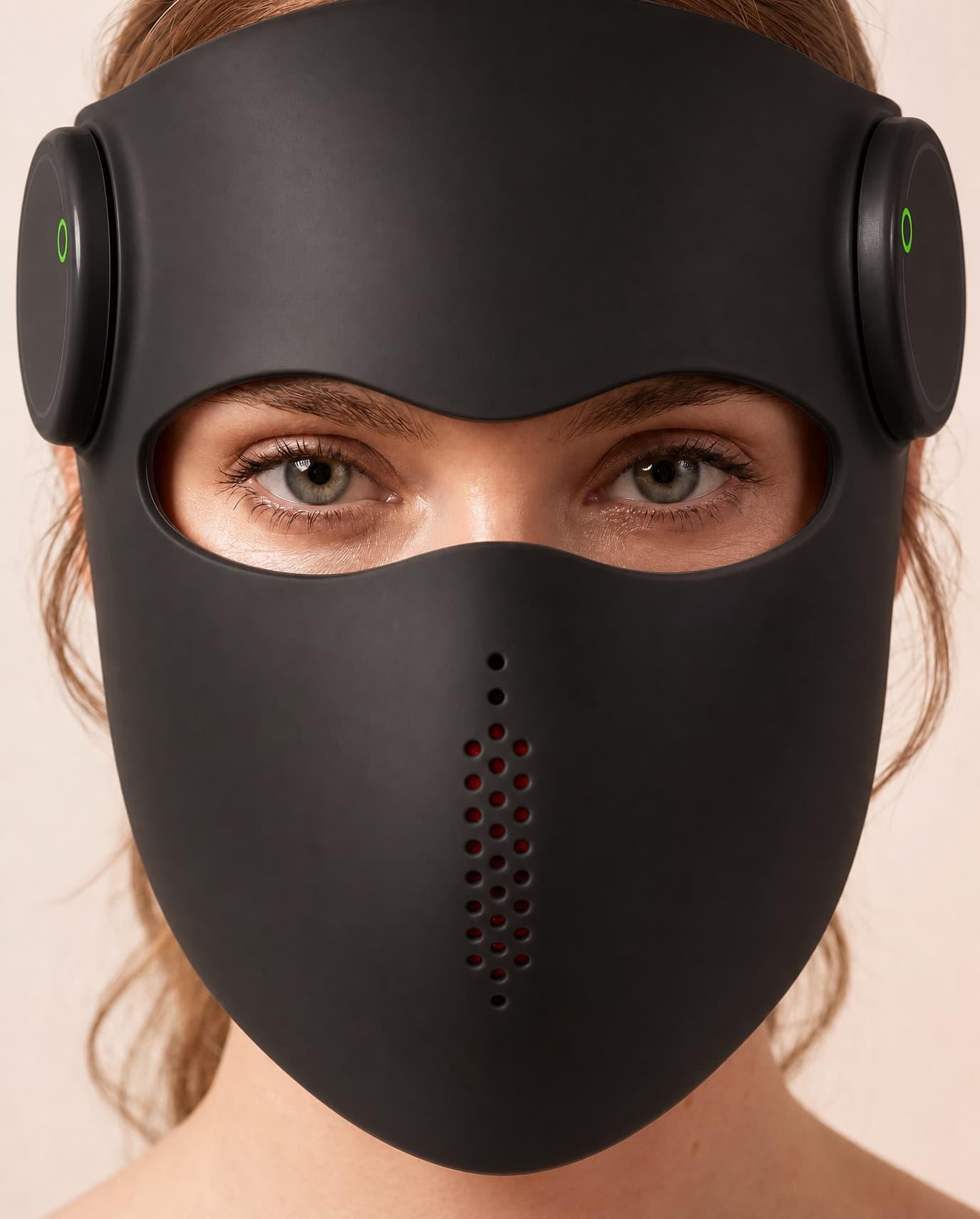
The mask leaves the eyes uncovered and positions light sources away from them — no goggles required. As with any light source, don't stare directly into it.
Food-grade silicone
The shell that touches your skin is soft, flexible, hypoallergenic food-grade silicone.
When to check first
If you're pregnant, have a photosensitive condition, or take photosensitizing medication, talk to your physician before starting.
Our standard
What we claim, and what we don't.
Lumière is built on the most-studied wavelengths in light therapy, cleared by the FDA, and measured in a 30-day consumer study. It is not a miracle, a cure, or a substitute for medical care — and we will never present it as one. We publish what the evidence supports, and nothing more.
Meet Lumière